For Australian contractors and tradespeople working on remote or off-road sites, a standard box trailer is rarely enough. You need secure, weatherproof tool storage, onboard power, off-road capability and — for longer regional jobs — somewhere to sleep. A purpose-built tradesman trailer addresses all of these in one tow-behind unit.
This guide covers what to look for when buying a heavy-duty tradesman trailer for Australian conditions, how Chinese-manufactured units compare to locally sourced options, and what specifications matter most for contractors operating in regional and remote Australia.
Key Takeaways
- A purpose-built tradesman trailer combines secure tool storage, onboard power and off-road capability in a single tow-behind unit — significantly more capable than a standard box trailer.
- Key specifications for Australian conditions include hot-dip galvanised or powder-coated steel chassis, independent suspension rated for corrugated tracks, and weatherproof drawer and compartment seals.
- Chinese-manufactured tradesman trailers offer a significant cost advantage over Australian-assembled equivalents, with factory-direct pricing and full customisation available for drawer layouts, electrical systems and tyre specifications.
- ADR road compliance is required for all trailers towed on Australian public roads — confirm the supplier provides a VIN-plated, road-legal unit.
- Models with integrated solar power and water storage extend the tradesman trailer concept to a self-contained remote work platform — suitable for contractors on multi-day regional jobs.
What Is a Tradesman Trailer?
A tradesman trailer is a purpose-built tow-behind unit designed to carry and organise tools, equipment and materials for tradespeople and contractors. Unlike a general utility trailer, a tradesman trailer features dedicated, lockable storage compartments — typically a combination of drawers, side access panels and a front toolbox — designed to organise and protect trade equipment during road transport and on-site use.
In the Australian context, tradesman trailers serve a wide range of trades and industries:
- Electrical and plumbing contractors — organised drawer storage for cables, fittings, meters and hand tools, with onboard power for testing equipment
- Construction and civil contractors — heavy-load rated platforms with secure compartments for site tools and safety equipment
- Mining and resources contractors — off-road capable units that can operate on unsealed mine access roads and gravel tracks
- Agricultural and rural contractors — trailers that combine tool storage with the ability to access remote properties and carry fuel or water
For contractors working away from the workshop — particularly on regional and remote jobs — a well-specified tradesman trailer reduces the number of vehicles needed on site, keeps tools secure and organised, and can provide self-contained power for tools and equipment.
Key Specifications for Australian Conditions
Australian conditions place specific demands on tradesman trailers that differ from European or North American specifications. Corrugated outback tracks, extreme heat, and long distances between service points require a higher standard of build quality than most locally sold utility trailers.
Chassis and Suspension
| Component | What to Look For | Why It Matters |
|---|---|---|
| Main chassis | RHS steel, minimum 75×50×4mm | Handles torsional load on corrugated tracks |
| Surface treatment | Hot-dip galvanised or heavy-duty powder coat | Rust resistance for coastal and humid regions |
| Suspension | Independent coil or leaf spring per axle | Reduces body flex on rough tracks |
| Axle rating | Rated to ATM (Aggregate Trailer Mass) | Legal compliance and load safety |
| Jockey wheel | Heavy-duty with hand brake | Stability when uncoupled on sloped sites |
Single-axle tradesman trailers suit contractors working primarily on sealed roads. For off-road and remote site access, a dual-axle configuration provides stability, redundancy if a tyre is damaged on a remote track, and higher load capacity.
Storage and Organisation
The utility of a tradesman trailer depends almost entirely on how well the storage system is designed for your specific trade. Key considerations:
- Drawer count and depth — deeper drawers suit plumbing and electrical fittings; shallower, wider drawers suit hand tools and power tools
- Drawer slide quality — heavy-duty ball-bearing slides rated for the weight of the tools they carry (standard furniture slides fail quickly under trade loads)
- Lock quality — individual drawer locks or a master lock system; consider whether site security requires individual drawer locking
- Side access panels — hinged or drop-down side doors for quick access to frequently used items without opening drawers
- Front toolbox — dedicated front compartment for larger, heavier tools or equipment kept separate from the drawer system
Onboard Power and Electrical
For contractors using power tools, testing equipment or lighting on site, an onboard electrical system significantly extends the trailer’s utility:
- Battery capacity — 100–200AH of AGM or lithium battery provides sufficient capacity for power tool charging and LED lighting
- Inverter — a 1,500–2,000W inverter allows standard 240V power tools to run directly from the trailer battery
- Solar charging — a rooftop solar panel (150–300W) keeps the battery maintained during daylight site hours without running a generator
- 240V shore power input — allows the battery to be charged from a site power outlet overnight
Off-Road Tyres and Roof Rack
- All-terrain tyres (LT designation) rated for the trailer’s ATM
- 265/75 R16 or equivalent — sufficient sidewall for rough tracks without excessive rolling resistance on sealed roads
- Spare tyre — a full-size spare mounted on the trailer is essential for remote work
- Roof rack — a rated roof rack for ladders, pipe or additional equipment
Tradesman Trailer vs Standard Box Trailer
Many contractors operate with a standard box trailer and wonder whether the investment in a purpose-built tradesman trailer is justified. The comparison depends on how the trailer is used:
| Factor | Tradesman Trailer | Standard Box Trailer |
|---|---|---|
| Tool organisation | Purpose-built drawers, lockable compartments | Open bed — tools must be packed in bags or cases |
| Security | Individual locking compartments | Single tarp or cage — low security |
| Onboard power | Battery, inverter, solar on higher-spec models | None |
| Off-road capability | Heavy-duty chassis, AT tyres, dual axle | Basic — not suited to rough tracks |
| Site presentation | Professional appearance | Utility appearance |
| Resale value | Higher | Lower |
| Initial cost | Higher | Lower |
For contractors who work primarily from a fixed base and only occasionally transport tools, a box trailer may be adequate. For contractors who work from the trailer on site — particularly in regional locations — the operational advantages of a purpose-built tradesman trailer justify the higher initial investment.
Models: What’s Available
Tradesman trailers range from compact utility units focused on tool storage to full-featured platforms with integrated power systems, making them suitable for everything from metropolitan trade work to extended remote site deployments.
Standard Configuration (Tool and Equipment Focus)
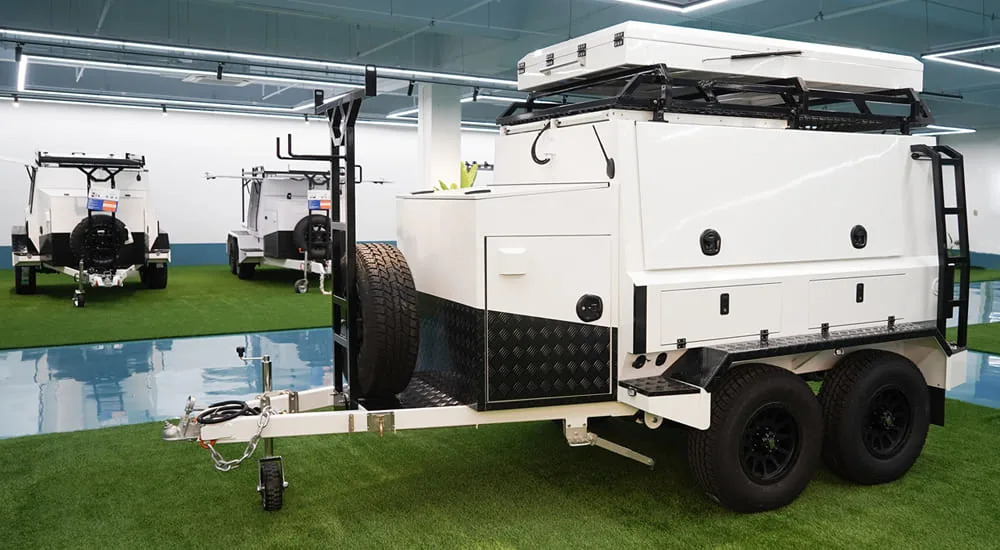
A standard tradesman trailer in the 3–4.5m range provides the core functionality most contractors need: lockable drawer storage, a front toolbox, roof rack and road-legal lighting. The Ecocampor TD2 is an example of this configuration — a dual-axle, off-road capable unit with waterproof storage drawers, full roof rack and a heavy-duty chassis suited for mine access roads and rural properties.
Extended Configuration (Work Platform with Power and Water)
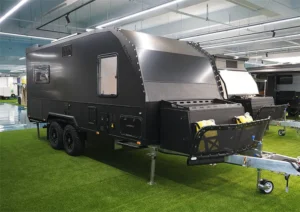
For contractors on multi-day regional jobs, an extended tradesman trailer adds a full solar-battery system and water storage to the tool storage platform — eliminating the need to book accommodation or source power on remote sites. The Ecocampor TD1 (Trade Wind) is a fully equipped example:
| Specification | TD1 (Trade Wind) |
|---|---|
| Exterior dimensions | 4,550 × 2,200 × 2,175mm |
| Interior height | 1,400mm |
| Tare mass | 1,600kg |
| GTM | 1,600kg |
| ATM | 3,500kg |
| Fresh water | 75L stainless steel tank with 12V pump |
| Power system | 2 × 100AH batteries, 2,000W inverter, solar panel with controller |
| Refrigeration | 50L Alpicool compressor refrigerator |
| Storage | Front lockable toolbox + multiple side storage drawers |
| Roof rack | Full-length movable roof rack |
| Tyres | 4 × 265/75 R16 all-terrain + full-size spare |
| Coupling | Australian standard coupler, 7-pin connector, electric brakes |
Cost: Chinese vs Australian-Sourced Tradesman Trailers
| Configuration | Australian Market Price | Chinese Manufacturer (Landed AUD) |
|---|---|---|
| Standard dual-axle utility (TD2 equivalent) | AUD 8,000–14,000 | AUD 10,000–14,500 |
| Extended with power and water (TD1 equivalent) | AUD 25,000–45,000 | AUD 21,000–31,000 |
For the extended configuration, the landed cost of a Chinese-manufactured unit is typically 30–40% below an equivalent Australian-assembled product — a saving of AUD 8,000–15,000 per unit that is particularly significant for contractors purchasing multiple units for a team.
Landed cost includes sea freight (approximately AUD 800–1,200 per unit in a shared container), import duty (rate subject to HS Code classification — confirm with a licensed customs broker) and GST.
For a broader overview of sourcing trailer products from China for the Australian market, see: The Complete Guide to Sourcing Caravans from China for Australian Dealers.
ADR Compliance for Tradesman Trailers
Any tradesman trailer towed on Australian public roads must comply with applicable Australian Design Rules and be registered through the relevant state or territory authority. Key compliance requirements:
- VIN plate — the trailer must have a Vehicle Identification Number plate confirming it meets applicable standards
- Lighting — ADR 13/00 and 45/01 compliant lighting (brake lights, indicators, tail lights, number plate light)
- Coupling — ADR 62/02 compliant towball coupling and safety chain
- Brakes — electric brakes required for trailers above a defined ATM threshold (ADR 38/04)
Ecocampor tradesman trailers are supplied with VIN plates and CE certification, with documentation packages available to support the Australian registration process. Contact the team to confirm documentation availability for your specific model.
Frequently Asked Questions
What is a tradesman trailer?
A tradesman trailer is a purpose-built tow-behind unit designed for tradespeople and contractors, featuring lockable tool storage drawers, weatherproof compartments and — on higher-specification models — onboard power and water storage. They are used across trades including electrical, plumbing, construction, mining and agricultural contracting, particularly for work in regional and remote locations.
How much does a tradesman trailer cost in Australia?
Standard dual-axle tradesman trailers with lockable drawers and roof rack cost AUD 8,000–14,000 from Australian suppliers. Extended models with solar power and water storage cost AUD 25,000–45,000. Chinese-manufactured equivalents landed in Australia typically cost 30–40% less — AUD 10,000–14,500 for standard configurations and AUD 21,000–31,000 for extended configurations, depending on specification and order volume.
What should I look for in an off-road tradesman trailer?
For off-road and remote site use, prioritise: dual-axle configuration (stability and redundancy), independent suspension, all-terrain tyres (LT designation, full-size spare included), hot-dip galvanised or heavy-duty powder-coated chassis, and ball-bearing drawer slides rated for tool loads. Verify the supplier can provide an engineering certificate or chassis documentation confirming the unit’s off-road ratings.
Do Chinese tradesman trailers comply with Australian road rules?
A Chinese-manufactured tradesman trailer must comply with applicable Australian Design Rules and be registered through the relevant state authority before it can be towed on public roads. Compliant units are supplied with VIN plates, ADR-compatible lighting and coupling. Confirm with the supplier that the unit includes the documentation required for Australian registration — a reputable manufacturer will supply this as standard.
Can I customise a tradesman trailer to my trade’s requirements?
Yes. Chinese manufacturers offering tradesman trailers typically accommodate customisation of drawer layout (number, depth, configuration), electrical system (battery capacity, inverter size, solar wattage), body colour, roof rack configuration and tyre specification. Customisation is typically available on minimum orders of 2 units or more, with drawing-based customisation for larger orders.
Ecocampor manufactures heavy-duty tradesman trailers including the TD1 (Trade Wind) and TD2 at its 60,000m² facility in China. Contact the team to discuss specifications, request a quote or arrange a sample unit inspection.