For Australian dealers considering their first import order from China, the stakes are high: a wrong supplier choice can mean substandard build quality, non-compliant vehicles, delayed shipments, and no practical recourse once the container leaves port. A structured evaluation process — applied before any order is placed — reduces these risks substantially.
This checklist covers the seven areas that matter most when assessing a Chinese caravan manufacturer for the Australian market.
Key Takeaways
- Verify ISO 9001 certification and legal business registration before any other evaluation step.
- A reputable manufacturer operates a dedicated caravan production facility of at least 20,000m² with multiple production lines — not a shared or contract manufacturing arrangement.
- ADR compliance documentation must be confirmed before order placement, not after arrival.
- Customisation capability, minimum order quantities, and payment terms should be negotiated in writing during the evaluation stage.
- After-sales support — spare parts availability, warranty terms and a local contact point — is the factor most commonly overlooked by first-time importers.
Step 1: Verify Certifications and Legal Business Status
Before visiting a factory or requesting samples, confirm the manufacturer’s credentials through verifiable documentation.
What to request:
| Document | What It Confirms |
|---|---|
| Business Licence | Legal registration, company age, registered scope of operations |
| ISO 9001 Certificate | Third-party quality management system audit — verify the issuing body and expiry date |
| CE Certificate | Compliance with European safety standards — widely used by manufacturers targeting export markets |
| Export Licence | Authorisation to export manufactured goods |
Certificates should be current, issued by a recognised third-party body, and specific to the manufacturer’s registered address — not a related entity or trading company. Request the originals or verifiable digital copies with the issuing body’s reference number.
Red flag: A manufacturer that cannot supply ISO 9001 documentation, or whose certificate is issued to a different legal entity than the factory you are evaluating, warrants additional scrutiny.
For context on what a credible supplier profile looks like in the Australian import context, see The Complete Guide to Sourcing Caravans from China for Australian Dealers.
Step 2: Assess Production Scale and Capacity
Factory scale is a reliable proxy for production capability, quality control infrastructure, and financial stability. A manufacturer producing caravans at export scale for multiple markets has invested in tooling, jigs, and process control that a small-scale fabricator cannot replicate.
Key metrics to assess:
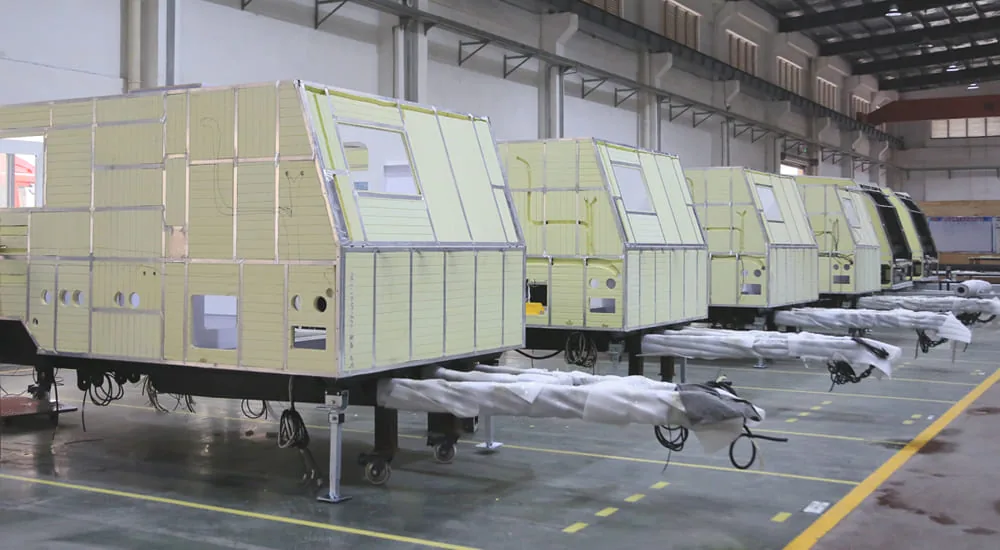
- Total facility area — a dedicated caravan manufacturer operating at export scale typically maintains a facility of 20,000m² or larger. Ecocampor operates from a 60,000m² dedicated facility with 12 production lines.
- Number of active production lines — multiple lines indicate capacity to fill orders without compromising lead times
- Annual production volume — ask for verified figures; cross-check against factory scale
- Workforce size and structure — dedicated R&D, QC, and after-sales departments indicate a mature operation
What to ask:
- What is your current monthly production capacity for the model I am interested in?
- What is your current order backlog and lead time for a new order?
- Do you manufacture under your own brand, or also as OEM/ODM for other brands?
A factory tour — in person or via video call — should be part of the evaluation for any order above a single unit. Pay attention to the organisation of the production floor, the condition of tooling and jigs, and the presence of a dedicated QC inspection area.
Step 3: Inspect Build Quality and Materials Specification
Caravan build quality for Australian conditions is not equivalent to European or domestic Chinese standards. Australian roads — particularly in regional and remote areas — impose torsional stress, vibration and temperature cycling that expose weaknesses in chassis, joinery and seal quality.
Chassis and structure:
- Main chassis rail material and section size (minimum 75×50×4mm RHS steel for off-road rated units)
- Surface treatment: hot-dip galvanising preferred over spray paint for corrosion resistance
- A-frame and drawbar attachment method and rating
- Suspension specification: independent coil spring or leaf spring rated to the ATM
Body and joinery:
- Composite panel construction vs timber framing — composite is lighter, more moisture-resistant
- Window seals and door seals: test for UV resistance and compression set
- Roof and floor joint sealing: points of water ingress are the most common long-term failure mode
Electrical and plumbing:
- Cable sizing and routing: undersized cables are a fire risk and a compliance failure
- 12V and 240V separation: confirm compliance with the electrical specification relevant to the model
- Water system fittings: stainless or marine-grade fittings resist the vibration-induced loosening that causes leaks in transit
Request a sample unit or arrange an inspection at the factory or a third-party inspection facility (SGS, Bureau Veritas, or CCIC) before placing a production order.
Step 4: Confirm ADR Compliance and Documentation
Every caravan towed on Australian public roads must comply with applicable Australian Design Rules and be registered through the relevant state or territory authority. This is a legal requirement, not an optional upgrade, and it must be addressed before the order is placed — not after the container arrives.
Key ADR requirements for caravans:
- ADR 62/02 — mechanical connections (coupling and drawbar)
- ADR 38/04 — brake systems
- ADR 13/00 / 45/01 — lighting and light signalling devices
- ADR 90/01 — external noise
Documentation to confirm with the supplier:
- Does the unit ship with a VIN plate?
- What documentation is provided to support Australian state registration?
- Has the manufacturer supplied units to Australian buyers previously, and can they provide a reference?
A detailed breakdown of the ADR compliance process for imported caravans is covered in ADR Compliance for Imported Caravans: What Every Australian Dealer Needs to Know.
Step 5: Evaluate Customisation Capability
Australian dealers frequently need to adapt a Chinese manufacturer’s standard model for local market requirements — different colour schemes, layout modifications, additional electrical capacity, or branding. A manufacturer’s ability to accommodate customisation in a structured, documented way is a key differentiator.
Questions to ask:
- What is the minimum order quantity (MOQ) for a standard model?
- What is the MOQ for a customised specification?
- Can you provide a technical drawing (CAD) for a customised layout before order confirmation?
- What is the lead time for a customised order vs a standard model?
- How are customisation specifications documented and confirmed?
A manufacturer offering drawing-based customisation — where your specification is confirmed in a signed technical drawing before production begins — provides a much stronger basis for quality control than verbal agreements or email specifications.
Ecocampor accommodates customisation from 2 units upward, with CAD drawing confirmation provided prior to production for non-standard specifications.
Step 6: Check References and Australian Market Experience
A manufacturer with existing Australian buyers has already resolved the most common first-import friction points: ADR documentation, port clearance, state registration, and warranty claims from the Australian side. Reference-checking is the fastest way to verify this.
What to ask for:
- Names or contacts of existing Australian customers (dealers or direct buyers)
- Photographs and delivery records of units already in the Australian market
- Any publicly available case studies or dealer testimonials
Questions to ask the reference:
- Did the units arrive as specified and on time?
- What documentation was provided for registration?
- Have there been any warranty or defect issues, and how were they resolved?
- Would you order again from this manufacturer?
Be cautious of manufacturers who cannot provide any verifiable Australian reference — particularly if their marketing materials claim significant Australian market presence.
Step 7: Clarify After-Sales Support, Warranty and Parts Availability
After-sales support is the factor most commonly overlooked by first-time importers, and the one most likely to create problems after delivery. Clarify the following before order placement:
Warranty terms:
- What is the warranty period and what does it cover?
- Are warranty claims handled via replacement parts shipped from China, or via a local agent?
- What is the process for a warranty claim, and what documentation is required?
Spare parts:
- Are common wear items (seals, locks, electrical components) available for direct order?
- What is the typical lead time for spare parts from China?
- Does the manufacturer maintain local stock in Australia or through a local partner?
Technical support:
- Is technical documentation (wiring diagrams, installation manuals) available in English?
- Is there a local contact point or agent in Australia?
A manufacturer with an established Australian distribution channel or designated importer provides a significantly lower after-sales risk profile than one supplying direct-to-dealer without local support infrastructure.
Contact the Ecocampor team to discuss after-sales support arrangements, spare parts availability and documentation packages for the Australian market.
Frequently Asked Questions
How do I verify a Chinese caravan manufacturer’s certifications?
Request the original certificate documents including the issuing body’s name, certificate number, and issue/expiry dates. Cross-check by contacting the issuing body directly (ISO, CE certification bodies including TÜV, SGS, Bureau Veritas) or searching the issuing body’s online certificate lookup if available. Be cautious of certificates that cannot be verified independently.
What is the minimum order quantity for a Chinese caravan manufacturer?
Standard production models are typically available as single units (1 MOQ), though pricing improves substantially at 3–5+ units. Customised specifications — modified layouts, colour schemes, electrical upgrades — generally require a minimum of 2–5 units to justify production setup costs. Confirm MOQ in writing during the evaluation stage.
How long does it take to receive a caravan order from China?
Production lead time for a standard model from a manufacturer with current stock is typically 45–90 days. Customised orders add 2–4 weeks for drawing confirmation and production setup. Shipping from China to an Australian port takes approximately 18–25 days. Allow an additional 1–2 weeks for port clearance and transport to your location. Total lead time from order placement to delivery is typically 90–120 days for a standard order.
Do Chinese caravan manufacturers provide English-language documentation for Australian registration?
Reputable export-focused manufacturers provide English-language technical documentation including owner manuals, wiring diagrams, and compliance documents. VIN plates are a standard requirement for export to regulated markets including Australia. Confirm the availability of registration-support documentation — including a letter of conformity or compliance statement from the manufacturer — before placing an order.
What quality control options are available before a shipment leaves China?
Third-party pre-shipment inspection is available through internationally recognised inspection firms including SGS, Bureau Veritas, and CCIC. Inspections are typically conducted at the factory prior to container loading and cover dimensional checks, materials verification, electrical testing, and visual quality assessment. Pre-shipment inspection costs approximately USD 300–500 per visit and provides an independent verification of the production quality before the shipment leaves China.
Ecocampor manufactures caravans, tradesman trailers and off-road camping equipment at its 60,000m² facility in China. ISO 9001 certified, CE certified, with VIN plates and ADR compliance documentation provided as standard. Contact the team to request factory credentials, a product specification sheet, or a reference from an existing Australian buyer.