For project managers and procurement teams evaluating remote accommodation for Australian mining and resources projects, the choice between a trailerised (relocatable) camp and a permanent modular camp is primarily a financial decision — but one where the right answer depends heavily on project duration, site permanence and the likelihood of redeployment.
This analysis compares trailerised and modular mining camps across capital cost, site setup, operating cost, and total cost of ownership over a three-year project cycle, with three illustrative scenarios.
Key Takeaways
- Modular camps typically offer a lower per-bed unit capital cost, particularly for large headcounts on long-term, permanent sites.
- Trailerised camps have higher initial per-unit costs but retain significant redeployment value — typically 60–65% of unit capital — and require less site infrastructure investment.
- For short-term projects (under 18 months), trailerised hire is typically the lowest-cost option when compared to purchasing a modular camp.
- For projects requiring relocation to a second site, trailerised camps avoid the cost of a second modular camp build — a saving that typically exceeds the trailerised unit capital premium.
- The crossover point where modular becomes cost-competitive depends on camp size, project duration, site infrastructure complexity and whether the camp will be relocated. Larger, longer-duration fixed-site camps generally improve the economics of modular construction.
- For small contractor teams (2–8 people), purpose-built tradesman trailers with integrated accommodation provide a self-contained work platform without camp-scale procurement overhead.
What Is a Trailerised Mining Camp?
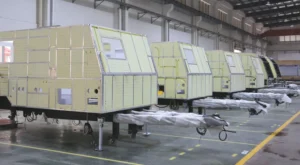
A trailerised mining camp is a relocatable accommodation facility assembled from road-registered trailer units — each unit serving a specific function: sleeping quarters, ablution, kitchen/dining, laundry, or recreation. Units are road-towed to site, connected to site services (power, water, waste), and commissioned as a camp. At project end, the units are disconnected and towed to the next site or returned to a hire fleet.
Typical configuration for a 20-person trailerised camp:
| Unit | Qty | Function |
|---|---|---|
| 2-berth accommodation trailer | 10 | Sleeping quarters (2 people per unit, 20 total) |
| Ablution trailer | 1–2 | Showers, toilets, basins |
| Kitchen/dining trailer | 1 | Commercial kitchen + dining for 20 |
| Laundry trailer | 1 | Washing machines, drying |
| Recreation/office trailer | 1 | Common area, site office function |
Primary use cases: exploration camps, construction camps, short-to-medium term project accommodation, camps requiring relocation between sites.
What Is a Modular Mining Camp?
A modular mining camp is constructed on-site from flat-pack or pre-engineered building modules — typically steel-framed rooms with integrated fitout, connected to site infrastructure. The camp is designed as a permanent or semi-permanent installation for the project’s duration.
Typical configuration for a 20-person modular camp:
- 10–12 room modules (single or twin share, to accommodate 20 persons)
- Ablution block module(s)
- Kitchen/dining module
- Site infrastructure: concrete pads or screw piles, reticulated power and water, septic or holding tank system
Primary use cases: long-term mine site accommodation (production phase), fixed camp locations with large headcounts, projects where the site will not move for 3+ years.
Capital Cost Comparison
Cost Model Assumptions: All figures are illustrative planning estimates based on indicative market pricing and should not be used as formal project budgets or supplier quotations. The model assumes a 20-person camp, standard specifications, accessible road freight, and existing site connection points. All costs are in AUD and exclude GST. Remote-area loadings, civil works beyond basic connections, generators, water treatment, permits and project-specific compliance requirements are not included. Actual costs vary significantly by supplier, specification, site location and project conditions.
The following table covers unit capital and freight only — the purchase cost of the camp units themselves. Site setup costs (foundations, services reticulation, connections and commissioning) are modelled separately in the TCO scenarios below, as they differ significantly between camp types.
| Cost Component | Trailerised Camp (20 persons) | Modular Camp (20 persons) |
|---|---|---|
| Accommodation units | AUD 800,000–1,100,000 | AUD 300,000–500,000 |
| Service units (ablution, kitchen, laundry) | AUD 200,000–350,000 | AUD 100,000–200,000 |
| Freight to site | AUD 15,000–40,000 | AUD 20,000–50,000 |
| Total unit capital | AUD 1,015,000–1,490,000 | AUD 420,000–750,000 |
| Per-bed capital cost | AUD 50,750–74,500 | AUD 21,000–37,500 |
At face value, modular offers a substantially lower capital cost per bed. The full picture changes when site setup costs, residual value and — critically — whether the camp must be relocated are factored in.
Three-Year Total Cost of Ownership
The following scenarios use midpoint unit capital figures (Trailerised: AUD 1,250,000; Modular: AUD 585,000) to illustrate how total cost of ownership develops across different project profiles. All figures are illustrative.
Residual value notes: Trailerised units are estimated to retain 60–65% of unit capital at project end, based on second-hand market demand for road-registered camp units in working condition. Modular camp residual value reflects modules after one full installation cycle; site infrastructure (foundations, reticulated services) is assumed to have negligible recovery value.
Scenario A: Single Site, 3-Year Project (20 persons)
| Cost Component | Trailerised | Modular |
|---|---|---|
| Unit capital | AUD 1,250,000 | AUD 585,000 |
| Site setup (connections, foundations, commissioning) | AUD 45,000 | AUD 185,000 |
| Maintenance (3 years total) | AUD 90,000 | AUD 75,000 |
| Decommissioning | AUD 15,000 | AUD 40,000 |
| Gross 3-year cost | AUD 1,400,000 | AUD 885,000 |
| Residual value at project end | (AUD 775,000) | (AUD 75,000) |
| Net 3-year cost | AUD 625,000 | AUD 810,000 |
On a single fixed site over three years, trailerised camps are cost-competitive with modular once residual value is factored in. The higher unit capital is substantially offset by the 60–65% retained value of road-registered units at project end.
Scenario B: Two Sites, 18 Months Each (20 persons)
| Cost Component | Trailerised | Modular |
|---|---|---|
| Unit capital (Site 1 purchase) | AUD 1,250,000 | AUD 585,000 |
| Site 1 setup | AUD 30,000 | AUD 185,000 |
| Site 1 decommissioning | AUD 5,000 | AUD 40,000 |
| Relocation / Site 2 unit cost | AUD 35,000 (towing + logistics) | AUD 585,000 (new camp purchase) |
| Site 2 setup | AUD 25,000 | AUD 185,000 |
| Maintenance (3 years total) | AUD 90,000 | AUD 75,000 |
| Site 2 decommissioning | AUD 10,000 | AUD 40,000 |
| Gross 3-year cost | AUD 1,445,000 | AUD 1,695,000 |
| Residual value at project end | (AUD 775,000) | (AUD 75,000) |
| Net 3-year cost | AUD 670,000 | AUD 1,620,000 |
Where a camp must be relocated to a second site, the trailerised approach delivers a dramatically lower total cost. The modular camp’s per-bed capital advantage is entirely offset by the requirement to purchase and commission a second camp. This scenario assumes the modular camp is not economically relocated; actual modular relocation costs depend on module design, foundation type, transport distance and site conditions.
Scenario C: Single Site, 18-Month Project — Trailerised Hire vs Modular Purchase
| Cost Component | Trailerised (Hire) | Modular (Purchase) |
|---|---|---|
| Unit cost | AUD 238,000 (~AUD 13,200/month × 18 months) | AUD 585,000 |
| Site setup | AUD 30,000 | AUD 185,000 |
| Maintenance | Included in hire rate | AUD 37,500 |
| Decommissioning | AUD 5,000 | AUD 40,000 |
| Gross cost | AUD 273,000 | AUD 847,500 |
| Residual value | — | (AUD 75,000) |
| Net cost | AUD 273,000 | AUD 772,500 |
For short-duration projects, trailerised hire eliminates the capital commitment of purchasing a modular camp that will not be fully utilised. The hire rate covers maintenance and the units are returned at project end with no decommissioning liability beyond site connection removal.
Mobility and Redeployment Value
The redeployment value of a trailerised camp is the factor most frequently underweighted in initial procurement decisions.
A trailerised camp unit:
- Can be road-towed to a new site in a standard prime mover and trailer combination
- Retains its value as a saleable or hireable asset after project completion
- Can be redeployed within 1–2 weeks of site closure at the first location
A modular camp, depending on its design and foundation type, may require substantial dismantling, transport and recommissioning to relocate — with costs that can approach a new build in some configurations. This makes modular camps most cost-effective when the site is confirmed as fixed for the full project duration.
For mining companies and contractors who manage multiple concurrent or sequential projects across different sites, a fleet of trailerised units functions as a depreciating asset that generates ongoing value across the project portfolio.
Setup Time and Lead Time
| Factor | Trailerised | Modular |
|---|---|---|
| Lead time from order | 6–14 weeks (hire) / 10–20 weeks (purchase) | 16–28 weeks |
| Site setup time | 3–7 days | 3–8 weeks |
| Services connection | Direct hookup to site supply points | Reticulated infrastructure typically required |
| Decommissioning time | 1–3 days | 2–4 weeks |
For fast-mobilisation projects — emergency accommodation, exploration drilling programs, short-notice contract wins — trailerised camps offer a significant lead time and setup advantage.
Which Is Right for Your Project?
| Project Profile | Recommended Approach |
|---|---|
| Duration < 18 months | Trailerised hire |
| Duration 18 months–3 years, single site | Trailerised purchase (net cost generally lower after residual) |
| Duration > 3 years, fixed site, large headcount | Modular may offer better per-bed economics — model the specific scenario |
| Multiple site deployments likely | Trailerised — avoids repeat camp build costs |
| Headcount < 40 persons | Trailerised |
| Fast mobilisation required (< 2 weeks) | Trailerised (hire from existing fleet) |
| Capital-constrained, long-term fixed site | Modular purchase or trailerised hire |
A Note on Small Contractor Teams
For contractors deploying small teams (2–8 people) on regional or remote jobs, full camp procurement — trailerised or modular — is typically neither necessary nor cost-effective.
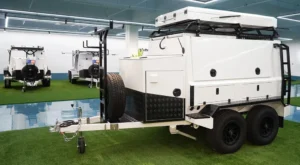
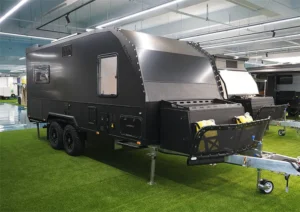
Purpose-built tradesman trailers with integrated sleeping quarters, water storage, solar power and refrigeration provide a self-contained work platform for small teams without the procurement, site setup, and compliance overhead of a full camp. For a site foreman and two crew members working a two-week remote rotation, a single extended tradesman trailer delivers the same core functions (secure tool storage, sleeping, power, water) at a fraction of the cost and complexity.
The Ecocampor TD1 (Trade Wind) tradesman trailer is an example of this configuration — a dual-axle, off-road capable unit with sleeping accommodation, 75L water, 2,000W inverter and full roof rack, suited to contractors working multi-day regional jobs without fixed site infrastructure.
Frequently Asked Questions
How much does a 20-person trailerised mining camp typically cost in Australia?
A 20-person trailerised camp typically costs AUD 1,015,000–1,490,000 to purchase (units plus freight, excluding site setup). Hire rates for a full 20-person camp run approximately AUD 12,000–16,000 per month for all units combined. Per-bed purchase cost ranges from AUD 50,750–74,500. These are illustrative planning estimates; actual costs depend on specification, supplier, remoteness and project conditions.
Is a trailerised camp cheaper than a modular camp?
On a per-bed capital basis, modular camps are typically cheaper upfront (AUD 21,000–37,500 per bed vs AUD 50,750–74,500 for trailerised). However, trailerised camps retain 60–65% of unit capital as residual value, require less site infrastructure investment, and avoid the cost of a second camp build if the project relocates. Over a three-year project on a single site, the two options are cost-competitive; trailerised is significantly cheaper for any scenario involving relocation or a project duration under 18 months.
How long does it take to set up a trailerised mining camp?
A trailerised camp can typically be commissioned within 3–7 days of units arriving on site, assuming site services (power connection point, water supply, waste management) are available. This compares to 3–8 weeks for a modular camp installation. Lead time for hire units is 6–14 weeks; for purchased units, 10–20 weeks.
Can a trailerised mining camp be relocated?
Yes. Trailerised camp units are road-registered and designed for repeated relocation. A 20-person camp can typically be disconnected, loaded and departed within 1–3 days. Relocation costs between sites (towing and logistics) typically range from AUD 25,000–50,000 depending on distance and unit count — compared to the cost of purchasing and commissioning a new modular camp at the second site.
What is the minimum headcount for a trailerised mining camp?
There is no practical minimum headcount for a trailerised camp — single units can serve as standalone accommodation for 1–4 people, and a full camp can be scaled from 4 to 100+ persons by adding units. For very small teams (2–6 people), purpose-built tradesman trailers with integrated accommodation are a more cost-effective alternative to camp-format procurement.
Planning a 10–40 person remote camp? Contact the team to discuss indicative unit specifications, camp configurations and project cost modelling for your site conditions.
For small contractor teams requiring self-contained work platforms for regional and remote Australian sites, Ecocampor manufactures heavy-duty tradesman trailers with integrated sleeping, power and water systems. Request specifications and pricing.