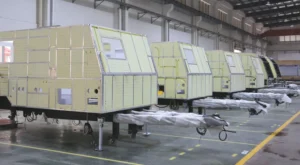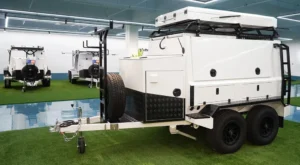
For Australian caravan dealers evaluating Chinese suppliers, the core question is not the FOB price — it is the total landed cost: what the unit actually costs to get from a Chinese factory to your dealership, ready to sell. This figure includes sea freight, insurance, import duty, GST and compliance preparation, all of which add to the factory gate price.
This article breaks down each cost component and provides an illustrative cost model for three caravan categories, compared against Australian wholesale equivalents. All figures are planning estimates — not formal quotations — and should be validated with supplier quotes, a licensed customs broker and a compliance specialist before use in any purchasing decision.
Key Takeaways
- Landed cost — not FOB price — is the correct figure to use when comparing Chinese and Australian-sourced caravans.
- The cost subtotal for Chinese-sourced caravans (excluding import duty and GST) is typically substantially below Australian wholesale equivalents. The margin varies by caravan category, specification parity, order volume and exchange rate.
- Import duty rate depends on HS Code classification and ChAFTA origin eligibility — confirm with a licensed customs broker before ordering.
- GST is assessed on the taxable importation value, which includes customs value, duty, and freight and insurance to the first Australian destination. GST is reclaimable as an input tax credit by registered businesses subject to normal ITC conditions.
- Currency risk is a material factor: a 5–10% movement in the AUD/USD rate can offset a significant portion of the cost advantage. Forward exchange contracts can help manage this exposure.
- Compliance preparation costs vary by volume, vehicle type and approval pathway — distinguish between per-model approval costs and per-unit registration costs in your budget.
What Is “Landed Cost”?
Landed cost is the total cost to bring one unit from a Chinese factory to your dealership in Australia, ready for retail sale or delivery to a customer. It includes:
| Cost Component | What It Covers | Basis |
|---|---|---|
| FOB price | Factory price + domestic Chinese freight to port of loading; risk transfers to buyer once goods are loaded on the vessel | Per unit |
| Sea freight | Ocean shipping from Chinese port to Australian port | Per shipment; allocate across units |
| Marine insurance | Cargo insurance (typically 0.5–1.0% of cargo value) | Per shipment |
| Import duty | Customs duty assessed on customs value (HS Code and ChAFTA eligibility determine rate) | Per unit |
| GST | 10% on taxable importation value (customs value + duty + freight and insurance to first Australian destination) | Per unit; reclaimable by registered businesses |
| Port and customs charges | Terminal handling, customs broker fees, AQIS biosecurity inspection | Per consignment; allocate across units |
| Inland freight | Transport from Australian port to your dealership | Per unit |
| Compliance preparation | Per-vehicle inspection and registration documentation (see Compliance section below) | Per unit |
Dealers who compare only the FOB price against Australian wholesale prices are comparing the wrong figures. The full landed cost — including all of the above — is the number that determines actual margin.
Cost Component Breakdown
FOB Price
FOB (Free On Board) is the price at which the manufacturer delivers the unit loaded onto the named vessel at the Chinese port of shipment. Domestic Chinese transport to port, export customs clearance and loading are included; all costs and risk after loading transfer to the buyer.
FOB prices vary by caravan type, specification and order volume. The ranges below are indicative for export-specification units from established Chinese manufacturers:
| Caravan Category | FOB Price Range (USD) | AUD Equivalent (at 0.65) |
|---|---|---|
| Compact single-axle (≤4m, basic fitout) | USD 5,000–8,500 | AUD 7,700–13,100 |
| Mid-range family caravan (4.5–5.5m, 2-axle) | USD 10,000–16,000 | AUD 15,400–24,600 |
| Premium off-road caravan (full fitout, off-road rated) | USD 18,000–28,000 | AUD 27,700–43,100 |
Note: AUD/USD 0.65 used for illustration (1 AUD = USD 0.65). The rate at time of payment determines the actual AUD equivalent — lock in your rate or use a forward exchange contract to manage exposure.
Sea Freight
Sea freight from a Chinese port (typically Shanghai, Ningbo or Tianjin) to a major Australian port varies by container configuration, unit dimensions and season. Most standard family caravans (2.3–2.5m wide, 5–6m body) are shipped one to two per standard 40ft container depending on packaging configuration.
| Shipping Configuration | Indicative Cost per Shipment | Per Unit (2 units) |
|---|---|---|
| One unit in a 40ft container (FCL) | AUD 2,500–4,500 | AUD 2,500–4,500 |
| Two units in a 40ft container | AUD 2,400–4,400 | AUD 1,200–2,200 |
| Multiple containers (larger orders) | Negotiate with freight forwarder | Varies by volume and dimensions |
Confirm actual per-unit freight cost with your freight forwarder based on your specific model’s dimensions, packaging, and container plan. Rates fluctuate with global shipping market conditions; peak periods can add 20–40%.
Marine Insurance
Marine cargo insurance is strongly recommended and typically required by financiers. Cost is approximately 0.5–1.0% of the declared cargo value (CIF basis). For a mid-range caravan with a CIF value of AUD 22,000, marine insurance adds approximately AUD 110–220 per unit.
Import Duty
Import duty is assessed on the customs value, which for most caravan imports is determined on a transaction value basis aligned with the FOB price. The applicable duty rate depends on the HS Code classification of the specific product.
China-Australia Free Trade Agreement (ChAFTA): Caravans qualifying as Chinese-origin goods under ChAFTA rules of origin may be eligible for a preferential duty rate that differs from the general MFN rate. To access ChAFTA preferential rates, the importer must hold a valid Form of Origin issued by the relevant Chinese authority or a declaration from an approved exporter, and the goods must meet ChAFTA rules of origin requirements. Confirm ChAFTA eligibility for your specific product with your customs broker before ordering.
Do not rely on a supplier’s stated duty rate. HS Code classification and origin eligibility are the importer’s responsibility. An incorrect classification can result in underpayment of duty, penalties and delays. Engage a licensed customs broker to confirm the applicable rate and ChAFTA eligibility before placing your first order.
GST on Imports
GST of 10% applies to the taxable importation value, which includes the customs value, plus applicable import duty, plus the cost of transport and insurance to the first place of destination in Australia.
Illustrative example (duty rate assumed for calculation only — confirm actual rate with customs broker):
- Customs value (FOB basis): AUD 20,000
- Import duty (illustrative): AUD 1,000
- Freight and insurance to first Australian destination: AUD 2,500
- Taxable importation value: AUD 23,500
- GST payable: AUD 2,350
GST paid on import is reclaimable as an input tax credit by GST-registered businesses, subject to normal input tax credit conditions. Confirm the applicable arrangements with your accountant or BAS agent.
Port, Customs and Inland Freight
| Cost Item | Indicative Range | Basis |
|---|---|---|
| Port terminal handling charges | AUD 200–400 | Per unit |
| Customs broker fees | AUD 350–600 | Per consignment — divide by number of units |
| AQIS biosecurity inspection | AUD 100–250 | Per consignment — divide by number of units |
| Inland freight (port to dealership, up to 300km) | AUD 300–800 | Per unit |
Compliance Preparation
The pathway to registering an imported caravan for use on Australian roads involves several distinct steps that carry different cost structures:
1. Vehicle Type Approval — Importers supplying more than 4 units of the same vehicle type within a 12-month period are generally required to obtain vehicle type approval through the applicable regulatory pathway under Australian law. This is a per-model, one-time cost that is separate from individual vehicle registration.
2. Register of Approved Vehicles (RAV) — Approved vehicle types are listed on the RAV. RAV listing is required before vehicles of that type can be supplied to the Australian market.
3. Individual Vehicle Approval (IVA) — For smaller volumes (typically 4 or fewer units of the same type per 12 months), an Individual Vehicle Approval via an Approved Vehicle Examiner (AVE) may be an available pathway, assessed on a per-vehicle basis.
4. State/Territory Registration — After satisfying federal approval requirements, each vehicle must be registered through the relevant state or territory authority before it can be driven on public roads.
The per-unit compliance preparation costs below refer to per-vehicle inspection and documentation costs only. They do not include one-time vehicle type approval or RAV listing costs, which apply at the model level and must be budgeted separately for first-import programmes.
| Compliance Scenario | Indicative Cost per Unit |
|---|---|
| Standard registration (documentation complete, VIN plate supplied, model previously approved) | AUD 200–500 |
| Individual Vehicle Approval via AVE (low volume, same type) | AUD 800–1,500 |
| First-import compliance assessment (new model, type approval pathway) | Obtain specialist quote — costs vary significantly by approval pathway |
A reputable Chinese manufacturer supplying to the Australian market will provide ADR-compliant specifications and a documentation package to support the registration process. Confirm with your supplier exactly which documents are provided and which approval responsibilities remain with the importer.
Illustrative Cost Comparison
Basis of Comparison: The table below models a 20-person illustrative order of 2 units sharing a 40ft container, at AUD/USD 0.65, with standard per-unit registration costs and indicative port/customs charges split across 2 units. Import duty and GST are excluded — add applicable duty and 10% GST on the taxable importation value to obtain a complete per-unit cost. Australian wholesale equivalents are indicative market price ranges for comparable-specification units; confirm against current supplier pricing for your specific models.
| Category | FOB (AUD) | Freight + Insurance | Port + Customs | Inland Freight | Compliance | Cost Subtotal* | Australian Wholesale Equivalent |
|---|---|---|---|---|---|---|---|
| Compact single-axle | AUD 10,400 | AUD 2,000 | AUD 850 | AUD 500 | AUD 350 | AUD 14,100 | AUD 18,000–28,000 |
| Mid-range family | AUD 20,000 | AUD 2,400 | AUD 950 | AUD 500 | AUD 400 | AUD 24,250 | AUD 40,000–60,000 |
| Premium off-road | AUD 35,400 | AUD 3,200 | AUD 1,050 | AUD 600 | AUD 600 | AUD 40,850 | AUD 75,000–110,000 |
* Cost Subtotal excludes import duty and GST. Add applicable duty (assessed on customs value) and 10% GST on the taxable importation value (customs value + duty + freight and insurance) to obtain a complete landed cost figure.
The cost subtotal advantage compared to Australian wholesale equivalents varies significantly by category and the specific Australian products used as the comparison baseline. Before drawing conclusions about dealer margin, confirm specification parity, applicable duty rate, and that the Australian wholesale figures reflect your actual supplier pricing rather than published retail prices.
What the Numbers Mean for Dealers
The cost advantage of Chinese-sourced caravans is real, but it is not uniformly captured as margin. Several factors determine how much of the cost subtotal differential translates into dealership profit:
Specification parity: Consumers will compare a Chinese-sourced caravan against locally available equivalents. If the imported unit has an inferior fitout, different chassis specification or missing features, a portion of the price advantage must be used to compete on price rather than captured as margin. Compare specifications in detail, not just categories.
Order volume: Freight and per-consignment charges (broker, AQIS, terminal handling) drop on a per-unit basis as order volume increases. A dealer shipping 4 units in two containers achieves a different per-unit cost to a dealer shipping 1 unit. Model your specific volume before finalising a landed cost estimate.
Exchange rate management: A 5% depreciation of the AUD adds approximately AUD 500–2,000 per unit on a mid-range caravan. Forward exchange contracts can help manage exchange-rate exposure between order placement and payment — discuss the options and associated costs with your bank or FX provider.
Compliance pathway and volume: Vehicle type approval costs are a one-time model cost that amortises across units over time. A dealer importing 20 units of the same model carries a much lower per-unit approval cost than one importing 2. Factor approval costs into your first-order economics.
Duty and ChAFTA: The difference between the MFN duty rate and the ChAFTA preferential rate can represent a material per-unit saving on mid-range and premium caravans. Confirm eligibility before ordering.
For a detailed overview of the ADR compliance requirements applicable to imported caravans, see ADR Compliance for Imported Caravans: What Every Australian Dealer Needs to Know.
For a broader guide to the sourcing process from supplier evaluation to first shipment, see The Complete Guide to Sourcing Caravans from China for Australian Dealers.
Frequently Asked Questions
What is the total landed cost of a caravan imported from China?
Landed cost includes FOB price, sea freight, marine insurance, import duty (rate confirmed by HS Code and ChAFTA eligibility — a licensed customs broker must advise), GST on the taxable importation value (reclaimable by registered businesses subject to normal ITC conditions), port and customs charges, inland freight, and compliance preparation. For a mid-range family caravan, an illustrative cost subtotal (excluding duty and GST) is approximately AUD 22,000–28,000. Add applicable duty and GST to obtain a complete figure.
How much is import duty on caravans from China?
Import duty is assessed at the rate applicable to the relevant HS Code classification, which must be confirmed with a licensed customs broker. Under ChAFTA, caravans qualifying as Chinese-origin goods may be eligible for a preferential duty rate. A valid Form of Origin or approved exporter declaration is required to access ChAFTA rates. Do not rely on a supplier’s stated rate — HS Code classification and origin eligibility are the importer’s responsibility.
What is the cost advantage of importing caravans from China?
The cost subtotal (excluding duty and GST) for Chinese-sourced caravans is typically substantially below Australian wholesale equivalents, with the gap varying significantly by caravan category, specification parity, order volume and exchange rate. The actual dealer margin outcome depends on applicable duty rate, specification match and compliance costs. Obtain itemised quotes for your specific model and volume before drawing conclusions about margin.
How does exchange rate affect the landed cost calculation?
The AUD/USD exchange rate at time of payment determines the AUD equivalent of the FOB price. A 5% movement in the rate adds or subtracts approximately AUD 500–2,000 per unit depending on caravan category. Forward exchange contracts can help manage exchange-rate exposure between order placement and payment — discuss options and costs with your bank or FX provider.
Do I need a customs broker to import caravans from China?
Australian importers may lodge customs entries themselves or use a licensed customs broker. For first-time caravan importers, using a licensed customs broker with experience in vehicle and trailer imports is strongly recommended — they will confirm the applicable HS Code and duty rate, advise on ChAFTA origin eligibility, handle AQIS biosecurity documentation, and manage port clearance. Broker fees for a standard shipment are typically AUD 350–600 per consignment, divided across the units in that shipment.
Ecocampor manufactures caravans and off-road trailers at its 60,000m² facility in China, supplying dealers in Australia with ADR-compliant documentation packages as standard. Contact the team to request FOB pricing, a product specification sheet, or a referral to an Australian customs broker experienced in vehicle imports.