When a national rental fleet operator needs to significantly expand its fleet, the procurement process looks nothing like a private buyer’s purchase or a dealership’s standard stock order. At scale, the supply chain itself becomes a competitive asset — and the decisions made in procurement directly determine whether a fleet operates profitably or spends years managing an inconsistent, expensive-to-maintain asset base.
This caravan fleet bulk order procurement guide examines how large rental fleets structure their supply chains, the models that support high-volume ordering, and what smaller fleet operators can learn from how the industry’s largest buyers approach supplier selection, specification management and delivery staging.
Key Takeaways
- Large fleet operators commonly use frame agreements — multi-year supply contracts with committed volumes and locked specifications — rather than placing discrete purchase orders.
- Specification consistency across all units is a primary procurement objective at scale. Supply chain discipline, not unit price, is what separates suppliers who can and cannot service large fleet accounts.
- Staged delivery — receiving units in tranches aligned to operational deployment requirements — is often used for larger fleet programmes to manage cash flow, quality feedback and market timing.
- Quality control moves upstream at high volumes: pre-production specification sign-off, version-controlled documentation, and factory inspection at key milestones are standard expectations for large fleet buyers.
- Fleet operators at smaller scales (10–50 units) can apply the same procurement disciplines — specification lock-in, staged delivery planning, pre-production sign-off — regardless of order volume.
The Scale Challenge
A single-location caravan hire operator with 15–20 units faces different procurement constraints from a national fleet operator with several hundred units across multiple locations. But the procurement disciplines that work at large scale were first developed and tested at small scale.
Understanding how large fleet procurement works is useful not because every operator will reach that volume, but because the frameworks — specification management, supplier qualification, staged delivery, quality control — transfer directly to smaller operations looking to grow efficiently and avoid the common pitfalls of an inconsistent fleet.
Why Specification Consistency Becomes Critical at Scale
At 10 units, an inconsistent specification is an inconvenience. At 200 units across multiple depots, it becomes a significant operational cost: separate parts inventories for each variant, technicians who need to diagnose before they can service, and guests who get a different experience depending on which unit they are allocated.
The procurement practices that have emerged from large fleet operations — locking specification before production, requiring factory sign-off, permitting no substitutions without prior written approval — reflect operational knowledge accumulated from managing mixed fleets at scale.
Caravan Fleet Bulk Order: Procurement Models
Frame Agreements
A common procurement model for large fleet programmes is the frame agreement (also known as a master supply agreement or preferred supplier agreement): a multi-year supply contract between the fleet operator and one or more manufacturers, specifying:
- The agreed caravan specification — floor plan, fitout, electrical, chassis — locked before any production run begins
- Annual or seasonal volume commitments
- Unit pricing at the committed volume
- Delivery staging (tranches, lead times, port of delivery)
- Quality standards and inspection protocols
- Warranty terms applicable to commercial rental use
- Provisions for specification amendments and the written approval process for any changes
Frame agreements give the fleet operator predictable supply and pricing over multiple seasons. They give the manufacturer committed volume that justifies production scheduling. Both parties accept constraints — the fleet operator commits to volume, the manufacturer commits to price — in exchange for planning certainty.
For manufacturers, a frame agreement with a large fleet operator is a fundamentally different commercial relationship from retail or dealership supply. The qualification process is more rigorous, the specification management requirements are more demanding, and the quality control expectations are higher.
Supplier Strategy: Single, Multiple, or Preferred + Backup
Large fleet operators use several approaches to supplier structure. Each reflects a different balance of operational risk and procurement complexity:
| Approach | Advantage | Risk / Trade-off |
|---|---|---|
| Single supplier | Maximum specification consistency, simplified parts management, deepest pricing relationship | Supply concentration — production disruption at one manufacturer affects the whole fleet cycle |
| Multiple suppliers | Supply diversification; ability to compare quality and pricing over time | Managing two or more supplier relationships while maintaining specification consistency across different manufacturing sources |
| Preferred + backup supplier | 70–80% volume through primary supplier (deepest relationship and pricing); 20–30% through qualified backup (supply continuity) | Requires qualifying and maintaining two supplier relationships; specification alignment between suppliers needs active management |
Many large Australian rental fleet operators who source directly from Chinese manufacturers start with a single-supplier relationship and evaluate their strategy once the primary relationship is established, understood, and performing consistently.
Staged Delivery
For larger fleet programmes, staged delivery is often used to align production, cash flow and operational deployment requirements. Rather than receiving an entire order in a single shipment, the fleet operator takes delivery in tranches aligned to its commissioning capacity and seasonal demand. As an illustrative example, a programme of 100+ units might be staged across 3–4 tranches over 12–18 months — but the actual staging depends on the operator’s operational capacity, cash flow structure and seasonal patterns.
Staged delivery serves several purposes:
- Cash flow management: Payment is staged across deliveries rather than concentrated in a single transaction.
- Operational capacity: The fleet operator can absorb and commission a manageable number of new units at a time, rather than processing a large volume simultaneously.
- Quality feedback: Issues identified in the first tranche can be reviewed and corrected before subsequent tranches are produced, reducing the risk of a systemic quality problem scaling across the full order.
- Market timing: Delivery can be aligned with seasonal demand peaks, ensuring new units are available for hire at the highest-revenue point in the calendar.
Quality Control at Scale
Pre-Production Sign-Off and the Fleet Specification Pack
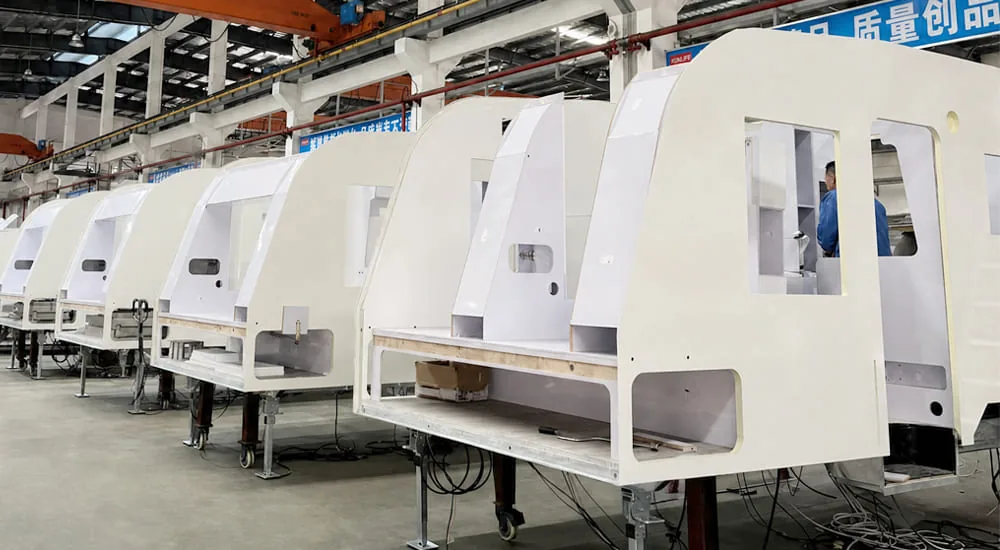
For any large caravan fleet bulk order programme, quality management moves upstream — into the specification agreement and pre-production process — rather than relying on end-of-line inspection alone.
Pre-production sign-off is anchored in a Fleet Specification Pack: a version-controlled set of procurement documents that define every aspect of the ordered unit before production begins. A complete Fleet Specification Pack typically includes:
- Engineering drawings: Floor plan dimensions, structural specifications, chassis layout
- Bill of materials (BOM): Component-level listing with approved brand/model for each item
- Approved supplier list: Identified manufacturers or brands for key components (appliances, electrical, chassis fittings)
- Revision history: Version-controlled record of any specification changes, with approval sign-off for each amendment
- Substitution process: Written procedure for requesting and approving any component change — no substitutions without prior written approval
Without a formalised specification pack, high-volume orders carry the risk of specification drift: small material changes, component substitutions or assembly variations that compound across many units and are difficult and expensive to rectify after delivery.
Factory Inspection at Key Milestones
Large fleet operators typically engage third-party inspection at key stages:
- Pre-production: Verification that materials and components match the approved BOM before production begins
- During production (mid-run): A sample inspection of partially completed units to identify assembly issues before they propagate through the full run
- Pre-shipment: Final inspection of completed units before loading — typically a percentage sample, with full inspection triggered if the sample reveals issues
The cost of factory inspection is small relative to the cost of receiving a large consignment of out-of-specification units and managing rectification after delivery.
Fleet Supplier Qualification Checklist
For fleet buyers evaluating manufacturers capable of supporting a high-volume programme, supplier qualification goes beyond a factory visit and a price comparison. The following areas reflect the assessment criteria that procurement-disciplined fleet operators apply:
1. Production capacity
- What is the manufacturer’s monthly output for the model type required?
- What is peak production capacity, and how far in advance is capacity committed?
- Can staged delivery tranches be accommodated within their production scheduling?
2. Fleet programme experience
- Has the manufacturer supplied 20+ or 50+ units of an identical specification to a single fleet buyer?
- Are there references from repeat fleet orders — not just individual sales?
- What is their process for managing specification across multiple production runs of the same model?
3. Specification management capability
- Can the manufacturer produce and maintain a version-controlled specification pack?
- What is their process for managing component substitutions when approved parts are unavailable?
- Is CAD drawing confirmation standard practice before each production run?
4. Spare parts and after-sales pathway in Australia
- Which key components are stocked domestically?
- What is the lead time for components that require international sourcing?
- Is there an in-country service support pathway, or does all after-sales route through the manufacturer?
5. Quality documentation
- Does the manufacturer provide per-unit inspection records at delivery?
- What quality certifications (ISO 9001 or equivalent) are maintained?
- What is the process for logging and resolving quality issues identified post-delivery?
6. Commercial warranty for fleet use
- Are commercial and rental use explicitly covered under the manufacturer’s warranty?
- Does warranty cover both parts and labour?
- What is the warranty response pathway for units operating in Australia?
What Smaller Fleet Operators Can Apply
The procurement disciplines that large fleet operators use are not exclusive to high-volume buyers. A fleet operator placing a 15-unit order can apply the same principles:
Lock specification before production. Request a confirmed specification document with component-level detail. Agree a substitution approval process in writing before production begins.
Inspect before shipment. For any direct-import order, engage a third-party inspector to review a sample of units before the container is loaded. The cost is manageable; receiving out-of-specification units after the container is at sea is not.
Plan staged delivery where viable. Even at 20–30 units, splitting an order across two tranches allows a quality review and operational absorption period before the second tranche is produced.
Treat warranty as a procurement item. The warranty terms applicable to your use case should be negotiated and documented before the order is placed, not requested after delivery.
For an overview of what to look for when evaluating a fleet supplier for Australian operations, see Bulk Caravan Purchasing for Rental Fleets: A Fleet Operator’s Guide.
For a full overview of direct sourcing from Chinese manufacturers — from factory due diligence to landed cost breakdown — see The Complete Guide to Sourcing Caravans from China for Australian Dealers.
Frequently Asked Questions
What is a frame agreement in caravan fleet procurement?
A frame agreement (also referred to as a master supply agreement or preferred supplier agreement) is a multi-year supply contract between a fleet operator and a manufacturer that locks in the agreed caravan specification, volume commitments, unit pricing, delivery staging and quality standards. It gives the fleet operator predictable supply and pricing over multiple seasons, and gives the manufacturer committed volume that supports production planning. Frame agreements are a common procurement model for rental fleet operators placing high-volume bulk orders.
How do large rental fleets manage specification consistency across many units?
Through a version-controlled Fleet Specification Pack: a set of procurement documents that locks all materials, components, dimensions and fitout details before any production run begins. This typically includes engineering drawings, a bill of materials with approved component brands, an approved supplier list and a revision history. No substitutions are permitted without prior written approval. Factory inspection at key milestones — pre-production, mid-run and pre-shipment — verifies that units match the approved specification before delivery.
What is staged delivery in a caravan fleet bulk order programme?
Staged delivery means receiving a large order in tranches — aligned to operational deployment capacity, cash flow and seasonal demand — rather than in a single shipment. It supports quality feedback between tranches: issues identified in the first tranche can be corrected before subsequent tranches are produced. The staging schedule depends on the operator’s specific requirements and is agreed with the manufacturer before production begins.
Can smaller fleet operators use the same procurement disciplines as large fleets?
Yes. Specification lock-in, pre-shipment inspection, and documented warranty terms are applicable at any order volume. A 15-unit order benefits from the same pre-production sign-off process as a 200-unit order — the cost of the discipline is low relative to the cost of receiving out-of-specification units. Staged delivery may not be available at smaller volumes, but the planning discipline transfers regardless of scale.
What should a fleet operator look for when qualifying a caravan manufacturer?
Key qualification areas include: production capacity and scheduling flexibility for the required volume, prior experience supplying repeat fleet orders (not just individual sales), specification management capability including version-controlled documentation and substitution processes, spare parts availability in Australia, quality certifications and per-unit inspection records, and commercial warranty terms explicitly covering rental and fleet use. Suppliers who cannot demonstrate prior experience with fleet programmes and structured specification management should be assessed carefully before committing to a high-volume order.
Ecocampor supplies caravans to Australian fleet operators and dealers, with CAD drawing confirmation and specification sign-off before every production run. If you are planning a fleet procurement programme, discuss your volume requirements, specification needs and delivery schedule with the Ecocampor team — we work with operators at a range of scales to develop a programme that fits your operational timeline.